The Early Hawaiian Monarchs
Hawaiian History Timeline


Search For Tours
100 years of the Hawaiian Monarchy


After years of warfare among competing aliʻi, Kamehameha achieved a major victory in 1795 when his forces conquered Oʻahu at the Battle of Nuʻuanu. By then, he controlled Hawaiʻi Island, Maui, Molokaʻi, Lānaʻi and Oʻahu. Kauaʻi and Niʻihau remained outside his direct control until 1810, when the ruler of Kauaʻi, Kaumualiʻi, acknowledged Kamehameha as sovereign, completing the political unification of the Hawaiian Islands.
After consolidating his power on Hawaiʻi Island, Kamehameha built a formidable military force. Western weapons and technology became an important advantage, particularly cannon and muskets, while foreign advisers including John Young and Isaac Davis assisted his campaigns. These resources helped transform warfare in Hawaiʻi and contributed significantly to Kamehameha’s rise.
It was of great advantage to the island chain that he achieved unification before foreign interests could tear apart the separately ruled islands. He made several deals with the British, who would play an important role in recognising the young kingdom as legitimate. Kamehameha’s absolute power and rule would lay the groundwork for his bloodline and kingdom to reign for the next 100 years.
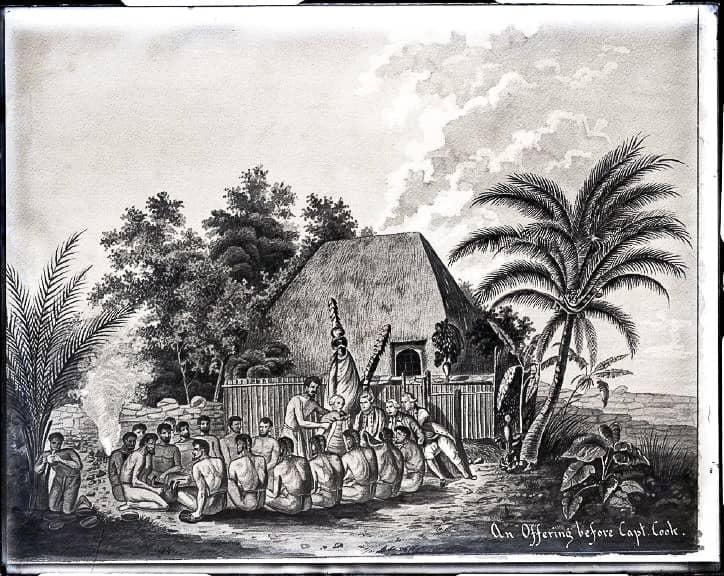
When Kamehameha I died in 1819, his son Liholiho succeeded him as Kamehameha II. He shared authority with Kaʻahumanu, one of Kamehameha I’s most powerful wives, who became Kuhina Nui and exercised considerable authority alongside the king. That same year, Liholiho publicly ate with women alongside Kaʻahumanu and his mother, Keōpūolani, breaking the traditional ʻai kapu and helping bring an end to the state religious system. Opposition led by Kekuaokalani culminated in the Battle of Kuamoʻo, where those seeking to preserve the old religious order were defeated.
American Protestant missionaries arrived in Hawaiʻi in 1820, after the kapu system had already been broken. Kaʻahumanu gradually embraced Christianity and became one of its most influential supporters, while the kingdom became increasingly connected to foreign trade. Sandalwood was especially valuable, but the trade also contributed to mounting debts among the chiefs and placed heavy demands on Hawaiian labor and natural resources.
In late 1823, Kamehameha II and Queen Kamāmalu traveled to Great Britain with a royal delegation hoping to strengthen Hawaiʻi’s relationship with Britain. Both contracted measles in London and died in July 1824. Kamehameha II’s younger brother, Kauikeaouli, succeeded him as Kamehameha III, while Kaʻahumanu continued as Kuhina Nui and regent until she died in 1832.


Big Changes for the Hawaiian Kingdom
Kauikeaouli succeeded his older brother as Kamehameha III and went on to become the longest-reigning monarch in Hawaiian Kingdom history. During roughly three decades on the throne, Hawaiʻi underwent an extraordinary political transformation from chiefly rule toward a written constitutional government with executive, legislative, and judicial institutions.
Along with Ka’ahumanu, Kamehameha III negotiated the first treaty with the U.S. in 1826. Establishing formal arrangements for friendship, commerce, and navigation between the two countries. Americans were also afforded the right to sue in Hawaiian courts and be protected by Hawaiian laws.
After Kaʻahumanu died in 1832, the young king began asserting greater independence from the chiefs and missionary influence that had shaped his early reign. Restrictions on activities such as hula and drinking became less rigidly enforced, even as debates continued within the kingdom over Christianity, Hawaiian cultural traditions, and the direction of the government. Kamehameha III spent much of his reign trying to navigate those competing forces.
He proclaimed “Mine is the kingdom of education” and opened the Chiefs Children’s School in Honolulu as well as schools throughout the islands. With the help of missionary teachers, he opened a college to train native educators and began printing Hawaiian language newspapers to inform and educate the populace.
Soon Hawaiian history and Western literature were published in Hawaiian, and the population quickly became avid readers. By the end of Kamehameha III’s reign, Hawaiʻi had developed one of the world’s most literate populations. Citizens were well-versed in the various political and social views of the world.
In 1839, Kamehameha III proclaimed the Declaration of Rights, establishing important protections for both chiefs and common people. The following year, he granted Hawaiʻi’s first written constitution. The Constitution of 1840 transformed the kingdom by placing government within a written legal framework and establishing legislative and judicial institutions alongside the monarchy. Hawaiʻi was entering a new era as a constitutional kingdom.
As the kingdom developed a Western-style constitutional government, Hawaiian chiefly ranks increasingly appeared alongside European-style royal titles in official documents and diplomacy. Kamehameha III also established clearer rules of succession and supported the education of young aliʻi who might eventually serve the kingdom in positions of leadership. Royal titles were solidified and confirmed when Kamehameha III published an official list of those eligible for the throne. Anyone on the list was required to attend the Chiefs Children’s School and was taught by protestant missionary teachers. The Chiefs’ Children’s School educated many of the highest-ranking aliʻi of the next generation. Its students included future kings Alexander Liholiho, Lot Kapuāiwa, William Lunalilo and David Kalākaua, as well as future queens Emma and Liliʻuokalani. Bernice Pauahi Bishop was another prominent student. The school prepared these young aliʻi for leadership in a kingdom increasingly engaged with Western governments and institutions.
Kamehameha III also worked to secure Hawaiʻi’s standing among the world’s independent nations. The United States had recognized Hawaiian independence through the 1826 agreement, and in 1843 Great Britain and France formally recognized the Hawaiian Kingdom as an independent state. Hawaiʻi subsequently developed diplomatic and consular relationships with nations around the world.


As teenagers, Liholiho traveled to Europe and the United States with his brother Lot as part of Kamehameha III’s education abroad program. During their 1849–1850 journey, Alexander and Lot traveled through the United States and Europe, meeting political leaders and gaining firsthand experience with foreign societies. While there, he learned to speak French, met President Louis Napoleon, and took fencing lessons. After visiting London, the two future kings sailed to the US. His experiences with racial discrimination in the United States had a lasting impact on him and contributed to his later skepticism toward growing American influence in Hawaiʻi. On a train, the conductor tried to remove Liholiho from his sleeping car, thinking he was a negro and at a diner party in Washington DC, a white servant refused to serve him.
He remarked at the time that anyone who paid his way could dine with the Queen of Paris no matter the color of their skin. This experience of discrimination helped shape the anti-American, pro-European attitudes and policies of his future reign. Alexander Liholiho succeeded Kamehameha III as Kamehameha IV.
A year after taking the throne, he married Emma Naea Rooke at the age of 21. His new queen was said to be a descendant of Kamehameha I’s brother. Three years later, their son Prince Albert Edward Kauikeaouli was born.
Native Hawaiian populations had continued to decrease, and he and Queen Emma established Queen’s Hospital to help with the illnesses decimating native Hawaiian people. Today it is known as Queen’s Medical Center. The Anglican Church was also established by the King and Queen, with Kamehameha IV translating the Book of Common Prayer into the Hawaiian language.
Personal tragedy marked the later years of Kamehameha IV’s reign. In 1859, the king shot his secretary and longtime companion Henry A. Neilson after becoming convinced by an unfounded rumor involving Queen Emma. Neilson survived the shooting but suffered lasting complications and died several years later.
The King’s remorse and grief over shooting his friend was compounded when his young son died in 1862. Suffering from asthma and grief, he died the following year at the age of 29.
He had named his young son Prince Albert heir to the throne. After his son’s death, Kamehameha IV died without naming anyone as his heir. After losing both her son and husband, Queen Emma remained one of Hawaiʻi’s most important civic and religious leaders. She helped raise funds for the Cathedral of St. Andrew and, in 1867, established St. Andrew’s Priory School for Girls, expanding educational opportunities for young women in Hawaiʻi.
Lot Kapuāiwa succeeded his brother Kamehameha IV in 1863 and took the throne as Kamehameha V. Long before becoming king, Lot had gained extensive experience in government, serving in several important public offices. He also developed substantial ranching interests on Molokaʻi, where lands associated with his estate later became part of what developed into Molokai Ranch.
Kamehameha V believed the monarchy had become too constrained under the Constitution of 1852 and called a constitutional convention in 1864. When the delegates failed to agree on a new constitution, the king dissolved the convention and proclaimed the Constitution of 1864 under his own authority. The new constitution strengthened the monarchy and eliminated the office of Kuhina Nui (prime minister).
Mark Twain wrote of him in 1866;
“He was a wise sovereign; he had seen something of the world; he was educated & accomplished, & he tried hard to do well by his people, & succeeded”.There was no trivial royal nonsense about him…He dressed plainly, poked about Honolulu, night and day, on his old horse, unattended; he was popular, greatly respected, and even beloved”.
He was the first King to bring back traditional kahuna practices. Laws were repealed concerning la’au lapa’au or Hawaiian traditional medicine, and a Hawaiian Board of Medicine was established with kahuna (expert) members brought to Honolulu to document their remedies.
He was a bachelor with no children when his sister Victoria Kamamalu died in 1866. Though he did not name a successor, he offered the throne to his cousin Bernice Pauahi Bishop, great-granddaughter of Kamehameha I, but she declined.
Before his death, he stated, “The throne belongs to (his cousin) Lunalilo; I will not appoint him, because I consider him unworthy of the position. The constitution, in case I make no nomination, provides for the election of the next King; let it be so.
He would be the last ruling monarch who was a direct descendant of Kamehameha I. The next monarch would be elected by the legislature.


William Charles Lunalilo was a grandnephew of Kamehameha I through his mother, Kekāuluohi. He was educated at the Chief’s Children’s School as one of the youngest students, along with numerous royal family members, as was required by Kamehameha III. He was admired for his scholarly abilities and memory for details. He loved writing, poetry, literature, and music. He composed “E Ola ke Aliʻi ke Akua,” one of the earliest national anthems of the Hawaiian Kingdom.
Native people called him “Lokomaika’i,” meaning generous or benevolent, and his friends affectionately called him “Prince Bill”. At the constitutional convention of 1864, he strongly supported a more democratic government that favored the people and gave less power to the king, drawing the ire of his cousin, Lot Kapuāiwa, Kamehameha V. When his cousin died, Lunalilo wanted the people to choose their next ruler.
He called for a general election, and there were several candidates running against him, including David Kalakaua and Bernice Pauahi Bishop (she had declined the throne earlier). Rather than simply claiming the throne, Lunalilo asked the Hawaiian people to express their preference in a popular election on January 1, 1873. He won by an overwhelming margin, although small numbers of votes were cast for other aliʻi. One week later, the Legislative Assembly unanimously elected Lunalilo king in accordance with the constitution, making him the first elected monarch of the Hawaiian Kingdom.
Lunalilo’s accession ceremony at Kawaiaha’o Church in 1873 was a simple ceremony. Though he reigned for only one year and 25 days, he championed the people’s voice and did not name a successor, believing the people should choose their leader. When he died of tuberculosis in 1874, his trait of “Lokomaika’i” followed him in death as the beloved king was buried in his own mausoleum at Kawaiaha’o Church in Honolulu.





 © 2025 Hawaii Tours. Photo by Kamerya Hanohano. All rights reserved.